
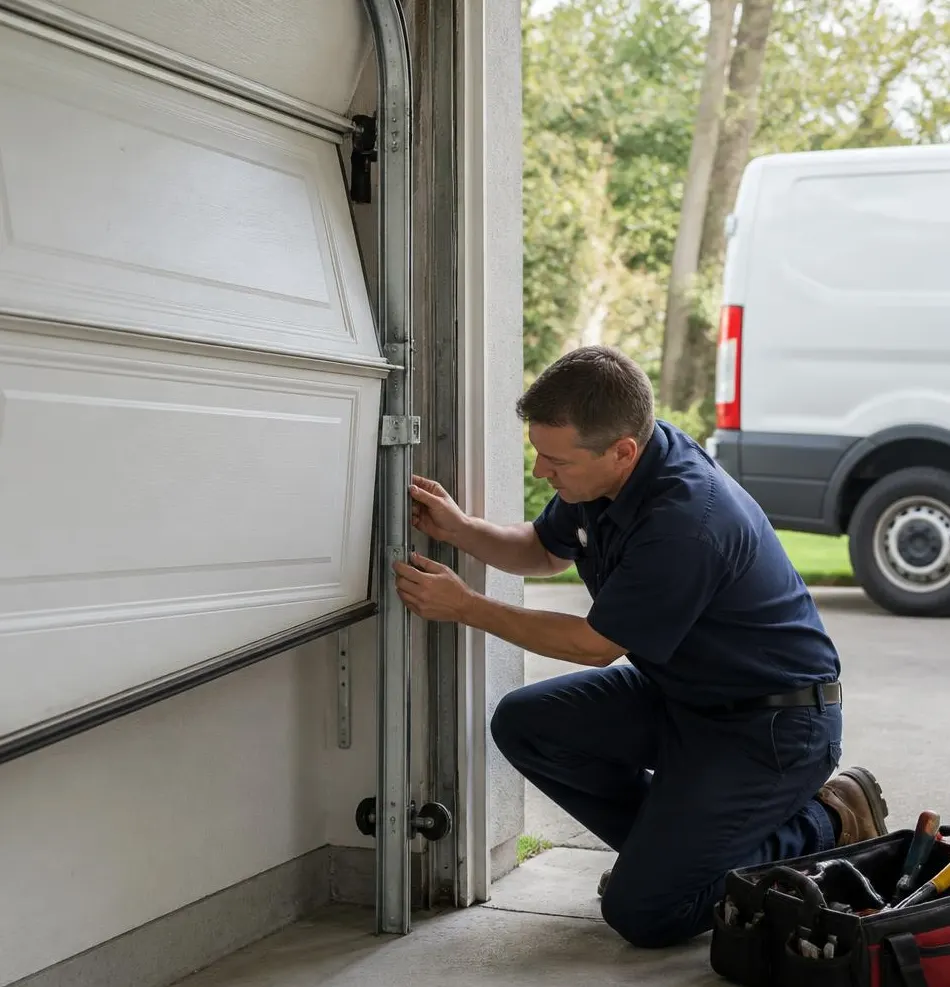
What a Technician Sees on This Call
The call usually starts the same way: a homeowner's door took a hit over the years from road salt, a wind-driven dent, or wood panels that swelled and cracked after one too many humid summers followed by a dry, cold winter. By the time we're called out, they're not just asking for a repair quote anymore — they want to know whether to replace the door with the same material or switch to something that will hold up better. It's a fair question, because the materials behave very differently once you factor in ice, salt spray from plowed streets, spring storms, and the big temperature swings this part of Missouri gets every year.
Steel Doors
Steel is the most common choice on homes here, and for good reason. It's affordable, comes in a wide range of styles, and stands up well to wind-blown debris during storm season. Most residential steel doors are insulated with a polystyrene or polyurethane core sandwiched between two steel skins, which helps with temperature swings in an attached garage.
- Strengths: Good wind resistance, low maintenance, wide style selection, relatively low cost (national ranges typically run from the low thousands into the mid-thousands installed, depending on insulation and style).
- Weaknesses: Can dent from hail or an errant basketball, and if the paint or galvanized coating is scratched, road salt tracked in on vehicle tires or splashed up during winter driving can start surface rust at the dent or scratch site.
- Climate fit: Solid all-around choice if you stay on top of touch-up paint and rinse off salt residue near the bottom panel through winter.
Wood Doors
Wood is the classic choice for carriage-style doors and older homes where curb appeal matters most. Nothing matches real wood for warmth and character, but it's also the highest-maintenance option in a climate with this much humidity swing.
- Strengths: Unmatched custom look, can be refinished or repainted repeatedly, good insulating properties if built with a solid core.
- Weaknesses: Humid summers followed by dry, cold winters cause wood to expand and contract, which leads to warping, cracked panels, and seal failure around the edges over time. Wood needs re-staining or repainting every few years to keep moisture out, and a neglected door can rot at the bottom corners where snowmelt and slush collect.
- Climate fit: Best for homeowners willing to commit to regular refinishing. Not the lowest-maintenance pick for this area, but still a strong option if the look is a priority.
Aluminum Doors
Aluminum shows up most often on garages with large glass-panel sections, giving a modern, light-filled look. It won't rust, which sounds like an advantage in a region that salts the roads — but it comes with its own set of trade-offs.
- Strengths: Rust-proof, lightweight (easier on the opener and springs), good for contemporary glass-and-aluminum designs.
- Weaknesses: Dents easily, even from hail or an accidental bump with a car bumper, and once dented it's hard to repair without replacing the panel. It also transmits cold more readily than steel or wood unless it's a well-insulated composite build, which matters during a hard freeze.
- Climate fit: Works fine for detached garages or homes prioritizing a specific architectural look, but it's not the most durable choice against Missouri hail and wind-blown debris.
Fiberglass Doors
Fiberglass is less common here but worth mentioning because it resists both moisture and dents better than aluminum, and it won't warp the way wood can.
- Strengths: Resists humidity-driven warping, won't rust, can be molded to mimic a wood-grain look without the maintenance.
- Weaknesses: Can become brittle and crack in sustained cold, and severe impacts can shatter a panel rather than just dent it. Color can also fade with years of sun exposure.
- Climate fit: A reasonable middle-ground option, but the cold-brittleness issue is worth weighing given how cold winters get here.
Composite (Wood-Composite) Doors
Composite doors use a wood-fiber composite skin over a steel or synthetic frame, aiming to combine wood's look with better weather resistance.
- Strengths: Resists moisture absorption better than solid wood, won't warp or rot the same way, holds paint and stain well.
- Weaknesses: Costs more than steel, and quality varies a lot by manufacturer, so it's worth asking about the specific product line and its warranty against moisture damage.
- Climate fit: A strong choice for homeowners who want a wood look without the upkeep headaches of real wood in a humid-summer, freeze-thaw-winter climate.
Our Recommendation for Typical Homes Here
For most attached garages in this area, an insulated steel door remains the most practical balance of cost, durability against wind and hail, and low maintenance — just plan on rinsing salt spray off the lower panels through winter and touching up any chips before they rust. If you want the carriage-house look without the wood upkeep, a composite door is worth the extra upfront cost. Save real wood for homeowners genuinely committed to refinishing on a schedule, and think twice about aluminum or fiberglass as your only defense against hail and storm debris unless it's paired with a sturdier frame.
When to Call Platte City Garage Door Repair
If your current door is showing rust at the bottom corners, panels that no longer sit flush after a warped winter, or storm damage that's left dents and misaligned tracks, it's worth having it inspected before you decide whether to repair or replace. Our team handles New Garage Door Installation for homeowners ready to switch materials, and we also do Cable & Track Repair when an older door just needs to be brought back into alignment rather than replaced outright. We'll walk you through which material actually makes sense for your garage's exposure, not just what's cheapest on paper.
If you're weighing your options or need a damaged door looked at before winter sets in further, call Platte City Garage Door Repair today — proudly serving Platte City, Parkville, Weston, Smithville, Leavenworth, Riverside, Weatherby Lake, and Camden Point, MO.